WARNING: Don't Take Your First Step Tomorrow Until You Read This
Why that one moment feels different, why daytime fixes can miss it, and what you can do about it the night before.

If you mentally prepare yourself before your first few steps every morning, this was written for you.
You know the routine. Alarm goes off. You sit up. You swing your legs over the side of the bed.
And then you wait.
Just long enough to brace.
“I dread getting up in the night to pee.”
The little plan you make before every first step
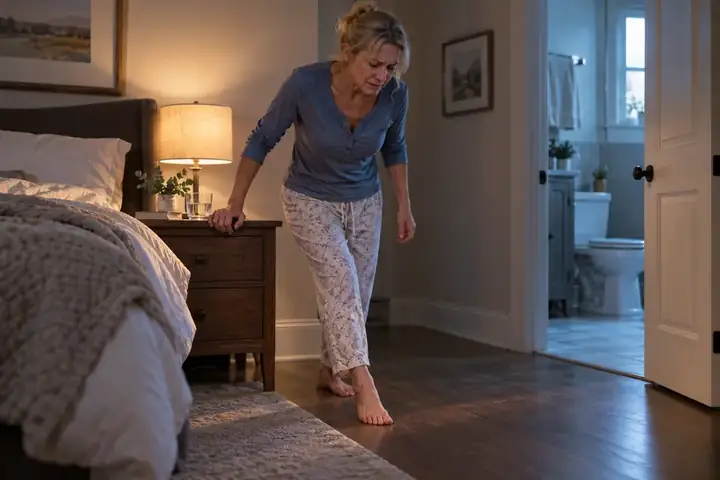
Maybe you put the other foot down first. Maybe you keep one hand on the nightstand, then the dresser, then the door frame.
Maybe you tiptoe to the bathroom. Maybe you limp the first stretch until it eases up.
“After walking for like 10 minutes i’m fine. But it’s still frustrating having to limp until then.”
It's a plan. You make it every morning. And again after sitting at your desk, in the car or on the couch.
It's one moment. But it sets the tone for the whole day.
“great looks like i’ll be dealing with this for the rest of my life from the looks of it.”
Here's the strange part. Your foot can feel fine while you're lying down.
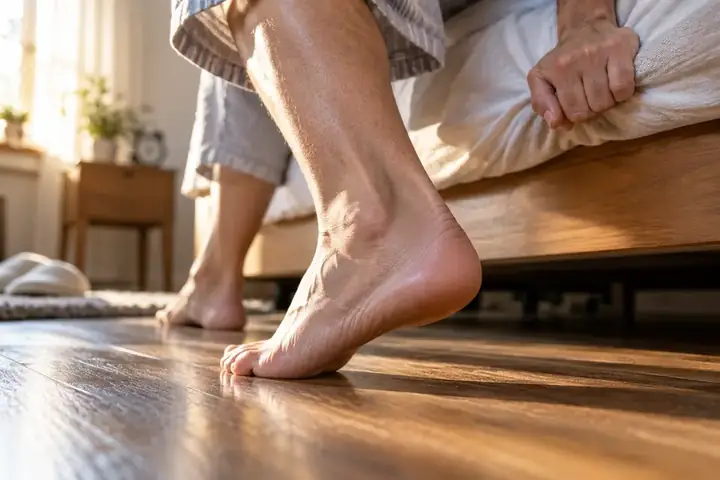
The trouble starts at one exact point: the switch from resting to standing.
For hours, your foot carries nothing. Then, in one second, it carries all of you.
So if the first steps are the hardest part, look at what happens before them.
Why your shoes and insoles miss the worst moment

Supportive shoes. Insoles. Stretches. A ball under your foot. Ice.
“I tried orthotics, physiotherapy, and even a cortisone shot—nothing worked.”
They're good choices. Many of them help once you're up and moving.
But you're probably not wearing shoes or insoles for those first steps out of bed. Your daytime help hasn't even started yet.
So keep what helps. And ask one new question:
What can I do tonight for tomorrow morning?
A simple answer: support your foot while you sleep
There's a whole category built for this: night splints. You wear one while you sleep.
It holds your foot gently upward through the night. So your foot isn't resting in a shortened position for hours. And the switch to standing isn't so sudden.
This isn't new. A 2023 clinical guideline for heel pain recommends a 1- to 3-month night-splint program for people with consistent first-step morning pain.¹
“I found they help with the pain in the morning, however will not cure your PF.”
So if the approach is known, why do people give up on it?
The 4 reasons people quit night splints
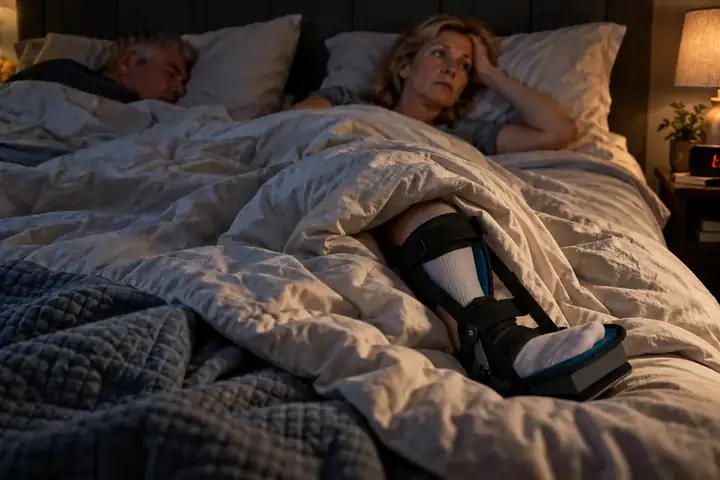
The classic night splint is a hard boot. It wraps behind your heel, under your foot and up your calf.
Boots work for some people. But people who've tried them keep saying the same four things:
- Bulk in bed
- Heat under the covers
- Catching on sheets and blankets
- The heel sliding up inside the boot
“I can’t sleep with it but wear it every now and then when I’m at home sitting.”
So the real question is simple:
Will you actually keep wearing it?
We built FirstStep around that question.
Same idea, without the boot: an open heel and front support
Traditional boots support your foot from behind and underneath. This one works from the front, and leaves your heel open.
That difference matters. In studies that compared the two, people found front-style night splints easier to tolerate than boots.²
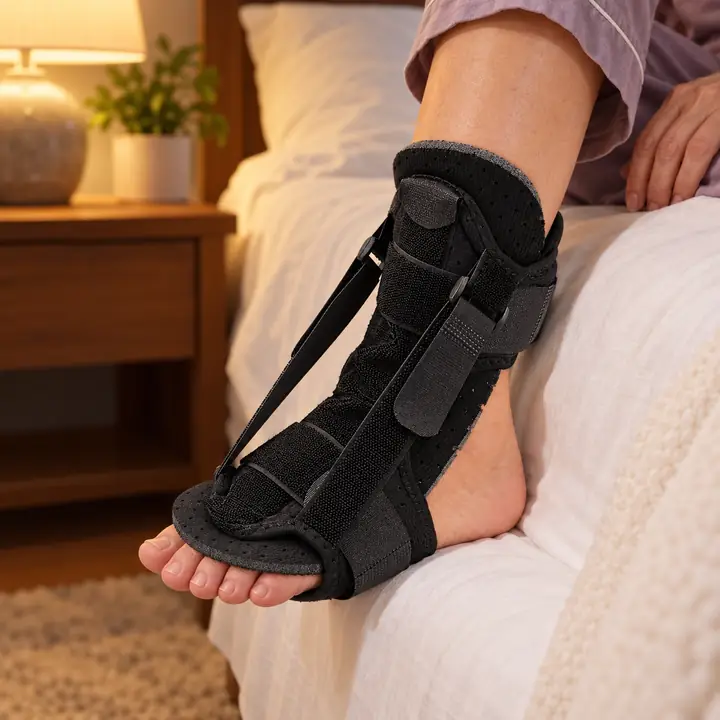
- Padded calf cuff around your lower shin
- Front aluminum support running down your shin to the top of your foot
- Soft forefoot padding across the top of your foot, with a soft pad under your toes
- Two Velcro straps that loop through buckles, so you can adjust the hold
- Open heel. No hard shell behind it. No rigid plate under your foot.
Less material wrapped around your foot than a boot. Less bulk in your bed. More of your foot open to the air, instead of sealed inside a hot shell all night.
How to get the fit right without guessing
With a lot of night splints, you're left to work out the fit alone. Guess wrong, and it ends up in a drawer.
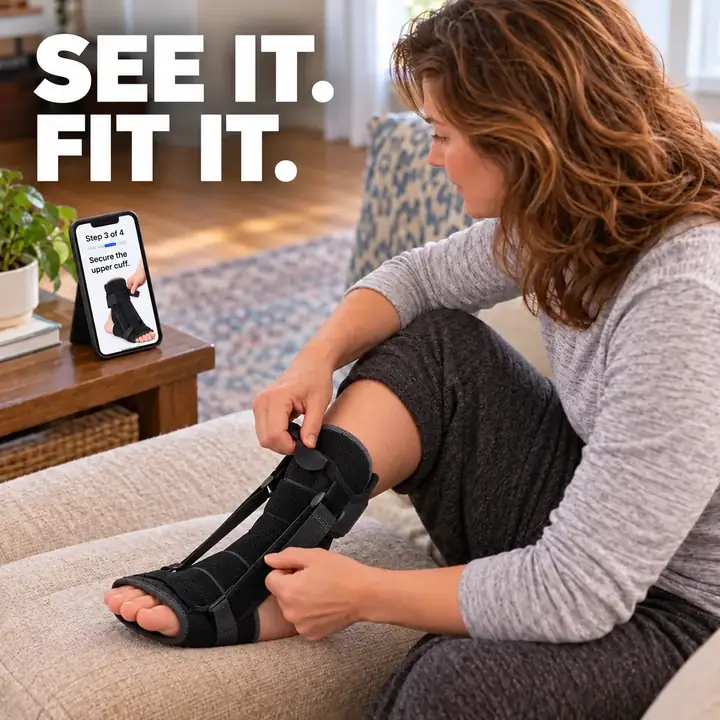
With FirstStep, you're not guessing. Your support comes with the Fit Hub, five simple guides:
Picture an ordinary morning

“Even taking away a little of the morning pain would be great.”
Picture a morning where you don't think twice before standing up.
No hand on the dresser. No slow, careful first step. No plan before standing. Just a calmer start to your day.
That's the shift. From the person who braces against the dresser every morning, to the person who handles it the night before.
You can test that morning for yourself, with a night-to-morning routine built around the exact moment you dread.
Your 4 biggest questions, answered
“I’m afraid I’m going to be throwing money at something…”
That's a fair worry. Here are straight answers.
Tomorrow morning is coming either way
You already know what it feels like. The pause. The brace. The hand on the wall.
For hours, your foot carries nothing. Then, in one second, it carries all of you.
Now you know why the night before matters. And you have a slimmer way to handle it.
The fitting guide takes out the guesswork. The guarantee takes out the risk.
On the next page, you'll see:
- What people say once they find a night splint they can actually sleep in
- A side-by-side: the classic boot vs. this front-style design
- Its real measurements, so you can tell if it fits your leg
- The simple night-to-morning routine, step by step
Every morning you wait is one more morning of bracing.
Stop bracing for the morning. Start handling it the night before.
See how it works →P.S. People who say a night splint helped them have one thing in common. They found one they could actually sleep in. On the next page, read what they say, and see how this one was built around that. See how it works →
¹ Koc et al., Heel Pain – Plantar Fasciitis: Revision 2023, Journal of Orthopaedic & Sports Physical Therapy. Plantar fasciitis is a common reason for pain in the first steps after rest, but other problems can feel the same. Only a doctor can tell you what's behind yours.
² Attard et al., 2011 (18 patients) and Howard et al., 2017 (a review of 6 studies), on front-style night splints.