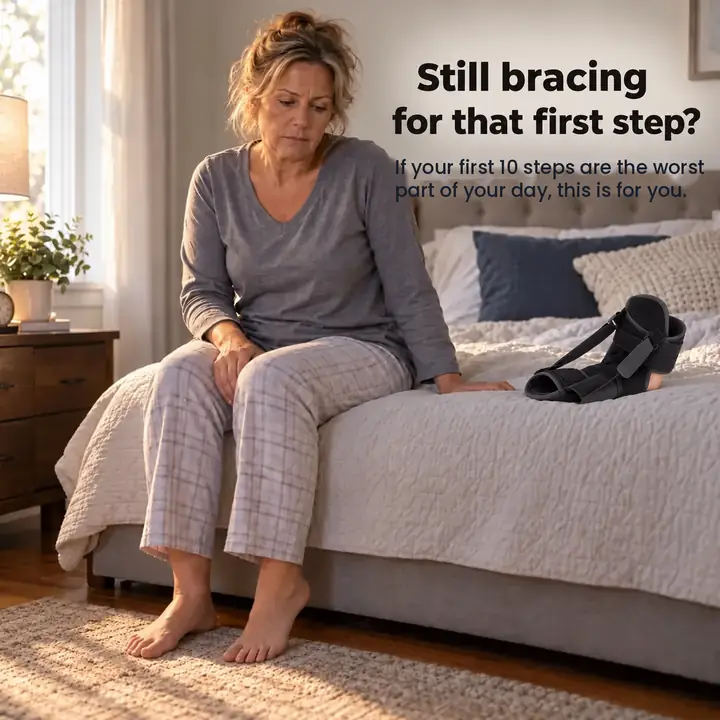
Every option includes Fit Hub access, free tracked US shipping and the 60-night fit-and-comfort guarantee. You'll get an order email right away, and tracking when it ships.
60 nights, risk on us
Night splints work over weeks, not one night. So wear it, sleep in it, give it a real try. If it doesn't fit or you can't get comfortable, we send you a prepaid return label.
Will my foot get hot?
Not the way it does in a boot. There's no shell sealing your foot in. Your heel, your toes and the sides of your foot stay open, and the padding is full of small air holes. Air moves around your foot all night.
Will it be bulky in bed?
No. Nothing sits behind your calf or under your heel. It rests on the front of your leg, slim enough to stay under the covers and out of the way.
Will it slip off while I sleep?
A padded cuff and two Velcro straps that loop through buckles hold it at several points. You set each one as gentle or as snug as feels right, and the fitting guide shows you exactly how.
Will it fit me?
It's one size, and every strap adjusts. Check its real measurements in the size guide further down.
Does it actually work?
Night splints get the strongest rating (Grade A) in the 2023 clinical guideline for heel pain.¹ They work over weeks, not one night. Start with a few hours, build up, and track your first steps each morning.
Picture tomorrow morning
“It only bothers me when i first wake up and move to the bathroom and back.”
— someone living with first-step heel pain
The alarm goes off. You sit up. You swing your legs over the side of the bed.
And this time, you don't stop to brace. No hand on the dresser. No slow, careful first step.
You just stand up and start your day.
That's the morning FirstStep is built for. Tonight, you put it on. Over the next weeks, you track how your first steps go.
Less in your bed. More of your foot left open.
Open heel.
No hot shell trapping your heel all night. No rigid plate under your foot.
Front aluminum support.
Holds your foot gently upward from the front, while you sleep.
Padded calf cuff.
Soft against your lower shin, where the support rests.
Soft forefoot padding.
Cushions the top of your foot, with a soft pad under your toes. Your toes stay free.
Two adjustable straps.
Velcro straps that loop through buckles, so you set the hold as gentle or as snug as feels right.
“Btw I specifically chose these, because I wanna have free toes”
— someone choosing a night splint
What you get
1Your FirstStep night support (one for each foot you choose).
2The FirstStep Fit Hub: step-by-step fitting guide, gradual comfort setup, a short routine before you stand, a simple morning tracker and a troubleshooting guide.
3Free tracked US shipping and the 60-night fit-and-comfort guarantee.
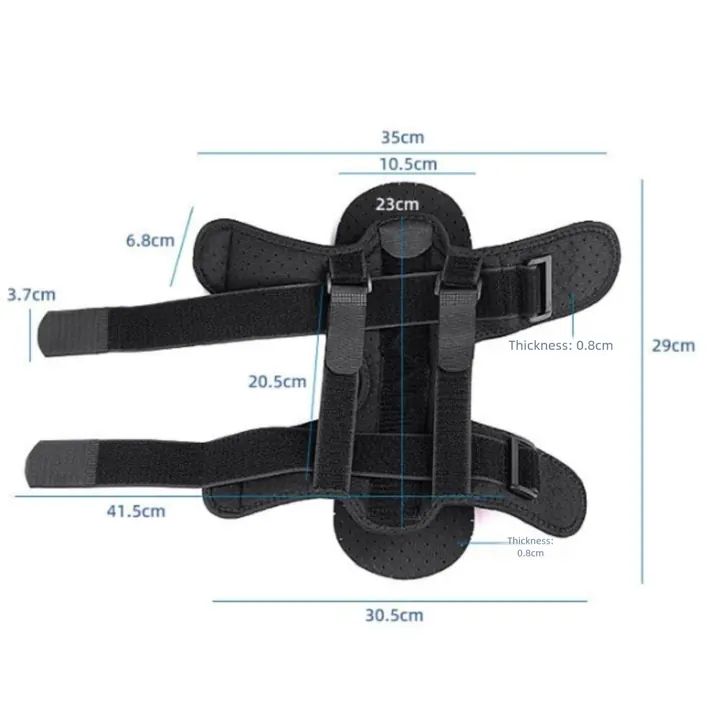
It's one size, and every strap adjusts. Here are its real measurements:
Top cuff (for your lower shin): 13.8 in (35 cm) across
Bottom band (for the front of your foot): 12 in (30.5 cm) across
Length, shin to toes: 11.4 in (29 cm)
Each long strap: 16.3 in (41.5 cm), adjustable
Soft padding: ⅓ in (0.8 cm) thick
You tighten or loosen each strap, so you fit it to your leg, not the other way around.
Boot vs. FirstStep, side by side
“There are so many options on Amazon. Does anyone have one they like?”
— someone shopping for a night splint
Here's the plain difference.
Traditional boot
FirstStep Night Support
Where the support sits
Behind the heel and calf, under the foot
Front of the shin and top of the foot
Heel
Wrapped in a shell
Open
Sides and bottom of foot
Mostly enclosed
Open, with a soft pad under the toes
Bulk in bed
Full shell
Slim, easy to sleep in
In studies that compared the two, people found front-style night splints easier to tolerate than boots.²
Tried a boot and quit because of the bulk, the heat or your heel sliding? This one has no shell around your heel at all.
What people who wear night splints say
Here's what people say once they find a night splint they can actually wear:
“Plantar fasciitis isn’t gone by any means, but the pain I feel with the first few steps in the morning is noticeably less.”
— someone who used a night splint
“Didn’t cure it, but it helps. I skipped it one night and could tell a difference.”
— someone who wore a night splint
That's why the 2023 clinical guideline for heel pain gives night splints its strongest rating for first-step morning pain.¹ The hard part was never the idea. It was wearing one all night. That's the part FirstStep is built to fix.
It's designed to keep your foot gently upward, so the switch to standing isn't so sudden.
Tomorrow morning
Take it off. Do the short routine before you stand. Take your first 10 steps, and log how they felt.
The weeks after
Adjust as you learn your foot. The troubleshooting guide is there if anything slips or presses.
This is how you stop bracing for mornings, and start handling them the night before.
How to get the fit right without guessing
Fit decides whether you keep wearing a night support. So yours comes with a step-by-step fitting guide. It shows you:
How each part goes on, in order
How snug is right for you
What to check if anything slips or presses
Start slow. You don't have to wear it all night on night one. Build up at your own pace.
A guideline-recognized approach¹
Night splints are a recommended approach for consistent first-step morning pain.
Questions?
Email us at [support email].
60 nights, risk on us
Prepaid return label if it isn't right.
¹ Koc et al., Heel Pain – Plantar Fasciitis: Revision 2023, Journal of Orthopaedic & Sports Physical Therapy. ² Attard et al., 2011 (18 patients) and Howard et al., 2017 (a review of 6 studies), on front-style night splints.
Our guarantee
The 60-Night Fit-and-Comfort Guarantee
“im scared to spend more money and it doesn’t work”
— someone living with heel pain
That's a fair fear. So here's the deal.
Your 60 nights start the day your order is delivered.
Put it on. Sleep in it. Adjust it. Use the Fit Hub. Give it a real, fair try.
If it doesn't fit you well, or you can't get comfortable wearing it, contact us within 60 nights of delivery and ask for a refund. We'll email you a prepaid return label. Send it back, and we'll refund you.
P.S. Think about tomorrow morning. If nothing changes, you'll sit on the edge of the bed and brace again. Or you can try something different, for about $1 a night, and take 60 nights to decide. Choose your option →
P.P.S. If both heels hurt, get two. Both are $89.95, so the second one costs just $30. That's the best value on this page.
FirstStep is not for you if…
You want something to walk in. It's for bed only.
Your pain came from a recent injury.
Your pain is new, severe or getting worse. See a doctor first.
If none of those fit, and your hardest moment is the first steps after rest, it was made for you.
Your questions, answered
Can I use it if only one foot hurts?
Yes. Choose one support for the foot that bothers you.
What if both feet hurt?
Choose Both Heels: two supports for $89.95, one for each foot. The second one is just $30.
Why buy this instead of a cheaper splint?
Because you're not just buying hardware. You get the support plus the system around it: a step-by-step fitting guide, a gentle start, a short morning routine, a progress tracker, troubleshooting help, free tracked US shipping and 60 nights to try it with a prepaid return label.
How long do I need to wear it?
There's no fixed schedule. Start with shorter wear and build up gradually. For context, the 2023 heel pain guideline describes night splints as a 1- to 3-month program. Your 60 nights is about two months, inside that range.
What if it doesn't help?
Results vary, and research on night splints is mixed. Some people notice easier mornings with steady use. Some don't. [Second line depends on guarantee scope]
Why didn't shoes or insoles fix my mornings?
They may still be helping during the day. But you're probably not wearing them for those first steps out of bed. That's the moment this is built for.
When will it arrive?
Shipping is free and tracked within the US. You'll get your tracking number by email once your order ships.
How do I clean it?
[Care instructions: add after supplier or sample check]
How do I reach you?
Email us at [support email].
Are you saying I have plantar fasciitis?
No. Plantar fasciitis is a common reason for pain in the first steps after rest, but other conditions can feel the same. Only a doctor can tell you what's going on.
How tight should it be?
Snug enough to stay in place. The fitting guide shows you how snug is right. Remove it immediately if you feel numbness, tingling, sharp pain, or color or temperature changes. Do not keep adjusting and wearing it through those symptoms. Seek medical advice if symptoms persist or concern you.
Can I walk in it?
No. Take it off before you stand, including trips to the bathroom at night. Undo the Velcro straps and slide it off.
Is it safe for my medical condition?
If you are pregnant, or have diabetes, nerve problems, circulation problems, recent surgery, open wounds, major swelling or a foot-drop diagnosis, talk to your doctor before using it.